What actually happens between signing a contract and your first elevator ride? We walk through every phase of a professional installation — from site survey to commissioning and client handover.
Most building developers have a reasonable understanding of what happens when a contractor builds a floor slab or installs an HVAC system. Elevator installation is less familiar — and that unfamiliarity leads to misaligned expectations, programme conflicts and avoidable delays.
This article is a transparent, detailed walkthrough of how a Skymax installation actually works — from the first site visit through to the moment we hand the keys to your facilities team. Our goal is to help developers and project managers understand what we need from the building at each stage, so that the process runs to programme.
8
Phases in a complete installation
4–8 wks
Typical installation timeline per elevator
Free
Site survey, traffic analysis and drawings
450+
Installations completed across East Africa
Phase 1: Initial Consultation and Brief
Every installation begins with a conversation. We need to understand the building type, the number of floors, the anticipated occupancy, the aesthetic vision and the budget envelope. We also need to understand any constraints — an existing shaft that must be reused, a landlord's specification that sets minimum parameters, or a programme that means the elevator must be commissioned by a certain date.
We ask a lot of questions at this stage, because it is far cheaper to resolve ambiguity now than after the shaft has been built to the wrong dimensions. The output of the consultation is a clear brief that both parties have agreed to — before any designs are drawn or any costs are committed.
Phase 2: Site Survey and Traffic Analysis
Our engineers visit the site — or, for new-build projects, review the architectural drawings — to conduct a thorough assessment. For existing buildings, this means physically measuring the shaft: pit depth, headroom, shaft dimensions at every floor, door opening sizes and the electrical supply available. For new builds, we review the structural drawings to confirm that the shaft as designed will accommodate the elevator as specified.
In parallel, we conduct a traffic analysis. Using internationally recognised calculation methods, we model the building's peak traffic demand, size the elevator (or elevator group) appropriately and recommend the optimal number of cars. The traffic analysis is provided to the client as a written report, with the methodology clearly explained.
Phase 3: Design, Specification and Proposal
Armed with the site survey and traffic analysis, we prepare a full design specification. This document defines every material aspect of the installation: the elevator type, rated load, rated speed, drive type, control system, door configuration, cabin dimensions and finish specification. It includes shaft layout drawings showing pit, overhead and landing door positions. It specifies the electrical supply requirements — transformer capacity, dedicated elevator circuits, earthing arrangements.
The proposal also includes a programme — a week-by-week timeline of when our team will be on site, what the building contractor needs to have completed before we can proceed, and the sequence of inspections and tests leading to commissioning. We provide this programme in detail because elevator installation is on the critical path of most construction projects. If the elevator cannot be commissioned, the building cannot receive its occupancy certificate.
The shaft must be ready before we install
A common source of programme delay is the assumption that elevator installation can begin before the shaft is complete. It cannot. We require the pit to be watertight and clean, the guide rail bracket positions to be correct per our drawings, the machine beam to be installed and the electrical supply to be available at the machine room or machine room-less position. Our programme specifies these requirements precisely — and we monitor them through regular site visits.
Phase 4: Manufacturing and Pre-Installation Preparation
Once the design is approved and the contract is signed, the elevator components are manufactured to specification. Hyundai Elevator's manufacturing quality control process is comprehensive — every component is tested before leaving the factory. The car structure, the drive machine, the control panel, the door operators and the cabin finishes are all manufactured to the agreed specification and shipped to site as a coordinated delivery.
In parallel, our site team prepares for installation. We review the structural drawings one final time, confirm the shaft status with the building contractor and schedule the delivery and installation programme. We also arrange the required scaffolding or temporary hoisting equipment for lifting materials into the shaft.
Phase 5: Installation
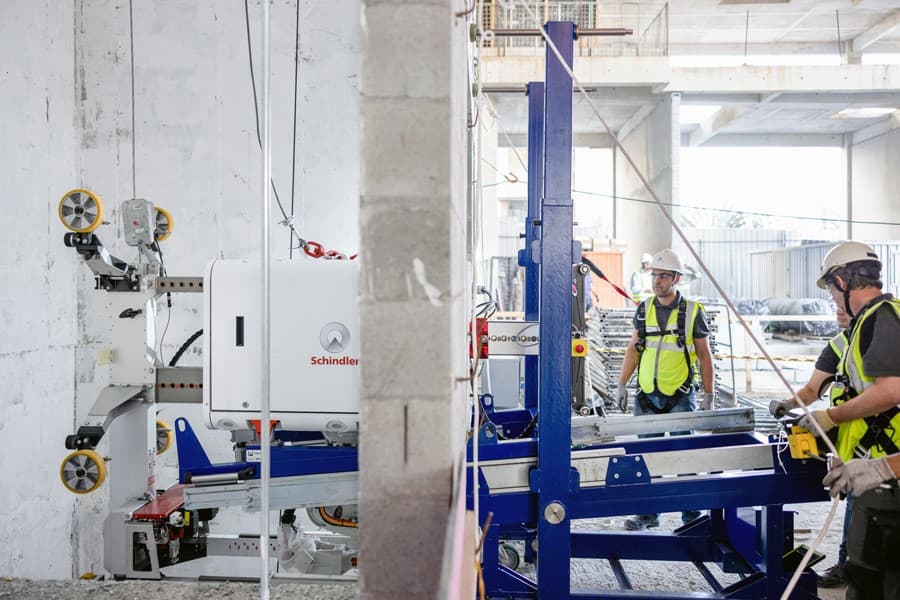
Installation proceeds in a defined sequence. It begins in the pit — installing the buffers and other pit equipment — and works upward. Guide rails are installed first, establishing the vertical reference line for everything that follows. The machine (for MRL systems, in the headroom; for conventional systems, in the machine room) is positioned and aligned. The car structure and counterweight are assembled in the shaft. The door operators and landing doors are installed at each floor.
Installation sequence summary
- Pit equipment: buffers, pit ladder, lighting and stop switch
- Guide rails: installed and aligned from pit to overhead
- Machine and drive: positioned, aligned and secured
- Suspension ropes or belt: installed and tensioned
- Car and counterweight: assembled in the shaft
- Control panel and wiring: installed in machine room or machine compartment
- Landing doors: installed and adjusted at every floor
- Cabin interior: panels, ceiling, floor, buttons and indicators
- Final wiring: travelling cable, safety circuit connections
Phase 6: Testing and Commissioning
Testing is the phase that separates a professional installation from an amateur one. We do not simply run the elevator up and down a few times and declare it commissioned. We conduct a systematic series of tests — each one documented in a commissioning record — that verify every safety device and every performance parameter.
Key commissioning tests
- No-load run: elevator operated through full travel with no passengers to check alignment and clearances
- Safety gear test: governor tripped under load to verify the safety gear grips the guide rails correctly
- Buffer test: car driven onto the buffer at reduced speed to verify correct energy absorption
- Door interlock test: all landing door interlocks tested for correct operation
- Emergency stop test: verified from inside the car and from the machine room
- Load test: elevator operated at 110% of rated load through full travel in both directions
- Speed test: actual car speed measured and compared to rated speed
- Levelling test: floor levelling accuracy measured at each landing — target ±5mm
- Emergency lighting and alarm: verified with main power isolated
- Two-way communication test: communication between car and rescue team verified
Phase 7: Client Handover and Training
Commissioning is complete only when every test has been passed and documented. We then arrange a formal handover meeting with the building owner or facilities manager. At handover, we present the full documentation package — test certificates, as-installed drawings, maintenance manual, spare parts list and the manufacturer's warranty documentation.
We also conduct operational training for the building's facilities team. This covers the normal operating procedures, the emergency procedures (including manual rescue for a trapped passenger), the routine checks the facilities team should carry out, and the maintenance schedule they should expect from their service contractor. We want the people responsible for the building to understand their elevator — not to rely on us for information that they should have at their fingertips.
Phase 8: Ongoing Partnership
Installation is the beginning of a relationship, not the end of one. Every elevator we install is enrolled in our preventive maintenance programme — scheduled visits at agreed intervals to inspect, lubricate, adjust and test all major components. We also provide 24-hour emergency response for all our maintenance clients, with response teams positioned across Nairobi, Mombasa, Kisumu and Tanzania.
We also carry out the annual statutory inspection required by Kenyan law — issuing the legally required certificate and providing a written defect report if any remedial work is identified. Our goal is a long-term partnership in which your elevator performs reliably for decades — because that is what builds the trust that brings us the next project.
Ready to Start Your Installation?
Contact our team for a free site survey and consultation. We'll conduct a traffic analysis, prepare a full specification and give you a transparent, no-surprises proposal — all at no charge. Let's build something together.
Get in Touch